
Automated Employee Onboarding Software: A Practical Guide for UK Businesses
A practical guide to automated employee onboarding software for UK businesses: compliance duties, leading HR tools, seven evaluation criteria and how to implement it.
By the we.simplify teamPublished 13 min read
In this article
- What Is Automated Employee Onboarding Software?
- Why Manual Onboarding Costs UK Employers More Than They Think
- Employee Onboarding Challenges UK Businesses Should Prepare for in 2027
- The UK Compliance Checklist Your Onboarding Automation Must Cover
- Best Automated Employee Onboarding Software for UK Businesses
- When an HR Platform Is Not Enough
- How to Choose: Seven Evaluation Criteria
- Implementing Onboarding Automation Without Disrupting HR
- Frequently Asked Questions
- Automate Onboarding Across HR, IT and Finance
A new employee can sign their contract on Monday, arrive on Thursday and still spend Friday waiting for system access, payroll confirmation or mandatory training. The problem is rarely a lack of effort. It is a failure of coordination between HR, IT, finance and operational teams.
Automated employee onboarding software can eliminate much of this friction, but digitising HR paperwork alone will not deliver an end-to-end onboarding process. The real opportunity is to orchestrate the entire sequence, from identity verification and contract execution to payroll provisioning, equipment allocation and role-specific access. As UK businesses prepare for 2027, evolving employment requirements, data security expectations and increasingly complex operations make connected onboarding workflows more important than ever. For mid-market organisations managing multiple systems and teams, the priority is to connect existing applications, enforce business rules and create an auditable process that scales with headcount.
What Is Automated Employee Onboarding Software?
Automated employee onboarding software coordinates the tasks, data transfers, approvals and communications required to move a successful candidate into an operational employee. It replaces disconnected administrative activities with defined workflows, triggers and completion conditions. It sits across HR, IT, payroll and finance, so every team knows what to do and when.
What It Replaces
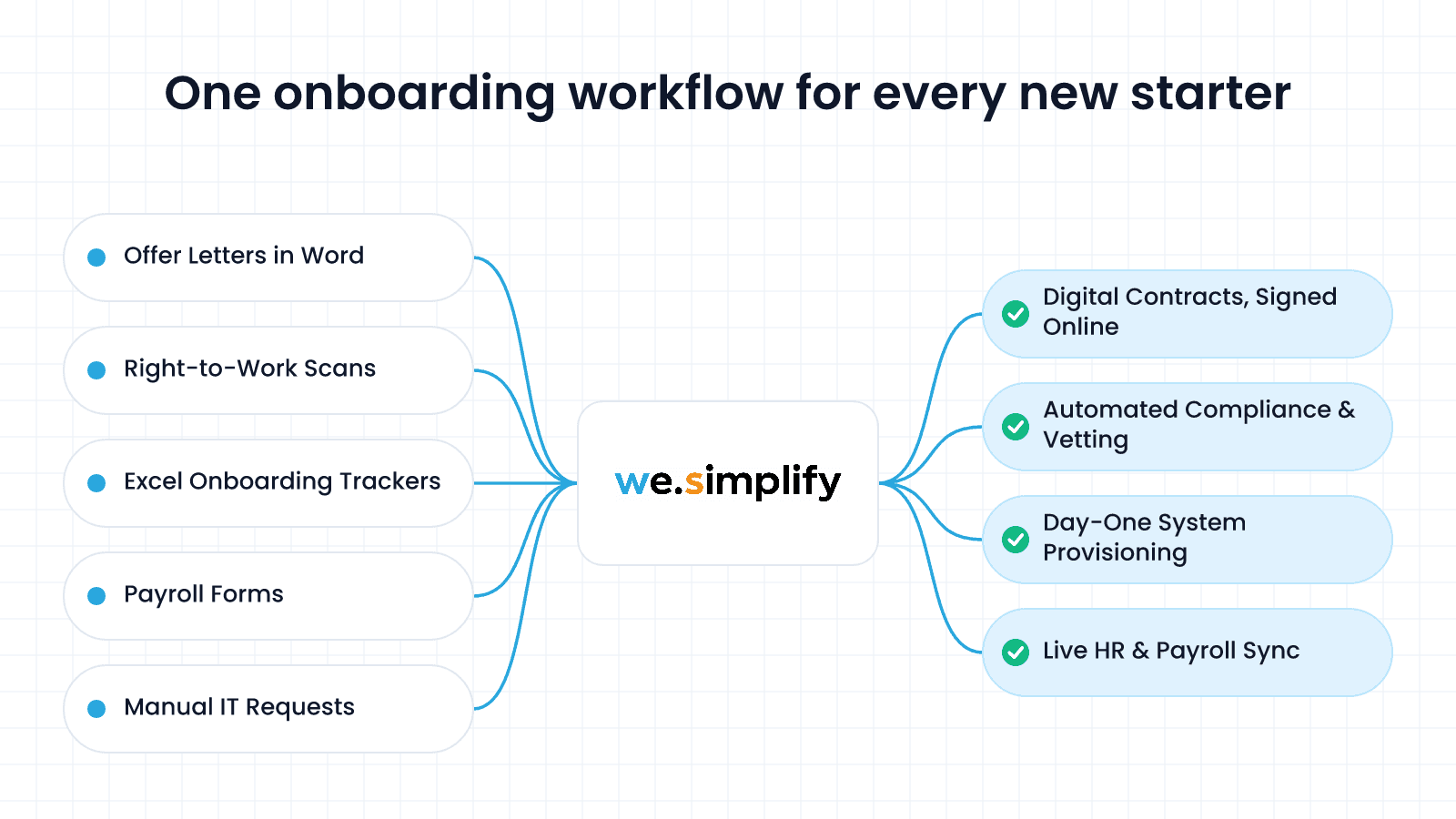
Instead of manually chasing signatures, copying employee details between spreadsheets and emailing IT about laptop requests, organisations can trigger these actions from a single hiring event. Employee data is collected once, validated and routed to authorised systems and teams.
The Core Components
A mature solution combines digital forms, e-signatures, task orchestration, document management, notifications, approval logic, integration connectors and audit logs. More advanced implementations use APIs and conditional rules to accommodate different departments, employment types, locations and approval hierarchies. An employee onboarding automation strategy should also include exception handling. Missing identity evidence, rejected documents and failed payroll synchronisation must trigger alerts and assign corrective actions so they never silently interrupt the workflow.
Onboarding Automation vs a Full HRIS
An HR information system (HRIS) manages employee records and broader people operations. Automated employee onboarding software focuses on orchestrating the activities that establish an employee's readiness to work. The two overlap, but they are not interchangeable. An HRIS may manage contracts and employee profiles while a separate orchestration layer connects HR to IT service management, finance, identity management and learning platforms.
Why Manual Onboarding Costs UK Employers More Than They Think
Manual onboarding costs more than most employers realise because every hand-off creates hidden work, risk and delay. Staff re-key data, chase approvals and fix errors across departments. Missed steps create compliance exposure, slow access delays productivity, and inconsistent processes grow with every new starter. The costs below add up quickly across a year of hiring.
The Admin Hours Behind One New Starter
Every manual hand-off introduces work: re-entering information, checking status, requesting approvals and resolving discrepancies. These costs multiply across multiple departments and hiring locations. For example, a business onboarding 100 employees annually can calculate its administrative exposure by multiplying the average hours spent per starter by the fully loaded hourly cost of the staff involved. That baseline provides a more credible business case than relying on generic software-savings claims.
Compliance Risk When Steps Get Missed
A missed right-to-work check, incomplete employment particulars or incorrect payroll setup can create consequences beyond administrative inconvenience. Automation improves control by assigning responsibilities, recording timestamps and escalating overdue actions. It does not, however, transfer legal accountability away from the employer.
Slow Time-to-Productivity and Early Attrition
Employees cannot contribute fully when they lack the tools, permissions, training or clarity required for their roles. Onboarding workflow automation helps coordinate these dependencies before the start date, reducing avoidable delays and giving managers visibility into outstanding blockers.
The Inconsistency Problem at Scale
Without standardised workflows, different managers create different onboarding experiences. A rules-based process can apply consistent minimum requirements while allowing controlled variations for job role, location, seniority and employment type.
Employee Onboarding Challenges UK Businesses Should Prepare for in 2027
For mid-market UK businesses, onboarding in 2027 will require more than digitising HR paperwork. Evolving employment requirements, growing technology complexity and pressure to improve operational efficiency make it important to review how new starters move through the business. The five challenges below are the ones to plan for now.
Preparing for Employment Law Changes
Upcoming employment law changes mean businesses should review their onboarding policies, employee communications and documentation processes. Workflows should make it easier to update requirements, assign responsibilities and track acknowledgements when policies or procedures change.
Maintaining Right-to-Work Compliance and Accurate Records
Right-to-work checks and employee records must be handled through appropriate procedures, with evidence and completion dates recorded correctly. Automated workflows can flag missing information, assign checks to responsible staff and escalate outstanding tasks without replacing the employer's legal responsibilities.
Connecting HR, IT, Payroll and Finance
As businesses grow, employee information often moves between separate HR platforms, payroll systems, IT service tools and finance applications. Disconnected systems can lead to duplicate data entry, delayed access and payroll errors. Integrating these systems helps coordinate tasks and keeps relevant teams informed throughout onboarding.
Protecting Employee Data Across Automated Workflows
Automation can move sensitive employee information across multiple systems, increasing the importance of access controls, secure data transfers and clear retention policies. Businesses should define who can access specific information and maintain appropriate audit trails as onboarding processes become more connected.
Measuring Onboarding Efficiency and Time to Productivity
Completing forms does not necessarily mean a new starter is ready to work. Businesses should measure time to operational readiness, administrative hours per starter, data correction rates and overdue tasks. These metrics help identify bottlenecks, evaluate the impact of automation and prioritise further improvements.
The UK Compliance Checklist Your Onboarding Automation Must Cover
Your onboarding automation must cover right-to-work checks, HMRC new starter and payroll setup, pension auto-enrolment, the written statement of employment particulars, and GDPR and data retention. Automation can collect evidence, assign owners and escalate overdue steps. Each duty below stays with the employer, so the workflow has to follow the legal procedure.
Right to Work Checks and Digital Identity Verification
Employers must complete the appropriate right-to-work check before employment begins. Depending on the individual's circumstances, this may involve a certified digital identity verification service, the Home Office online checking service or a manual document check.
From 1 October 2026, employers using a digital identity verification service for prescribed digital right-to-work checks must use an eligible certified and registered provider to obtain a statutory excuse. A workflow should record the check method, evidence, responsible reviewer and relevant dates. Digital automation must follow the applicable legal procedure.
HMRC New Starter Checklist and Payroll Setup
Payroll needs accurate identity, employment and tax information before processing pay. Where an employee does not have a P45, the HMRC starter checklist can provide the information required to establish their tax code. Systems should validate mandatory fields and route exceptions to payroll instead of assuming that a completed onboarding form guarantees correct payroll configuration. Employers must report new employees to HMRC on or before their first payday, as set out in the HMRC guidance.
Pension Auto-Enrolment Duties
Eligible workers must be assessed under workplace pension rules, with applicable enrolment, communications and contribution responsibilities managed correctly. Automation can trigger assessments, send notifications and track required actions, but eligibility and postponement rules must be configured accurately. Employers retain responsibility for meeting their duties.
Written Statement of Employment Particulars
The principal statement of employment particulars must be provided on the first day of employment, with the wider written statement generally due within two months. Automated document generation, electronic signatures and delivery records can help demonstrate that required information was issued on time. See the Government guidance.
GDPR, Data Retention and Employee Records
Employee records should be collected for defined purposes, accessed according to role and retained only for as long as necessary under applicable legal requirements. Configure access controls, secure transfers, retention schedules and deletion procedures. An audit trail should record relevant actions without unnecessarily duplicating sensitive personal data.

Best Automated Employee Onboarding Software for UK Businesses
There is no universal winner. The right platform depends on workforce complexity, UK payroll requirements, existing systems and how much onboarding coordination is needed across departments. The table below compares seven HR platforms worth considering, by what each is best for, UK payroll support, key integrations and pricing model.
Tool | Best for | UK payroll and compliance support | Key integrations | Pricing model |
|---|---|---|---|---|
Breathe HR | Core HR and structured onboarding for UK businesses | UK-focused HR features; payroll can be connected through Xero rather than assuming a complete built-in payroll solution | Xero, Outlook and other available integrations | Published employee-band plans, starting at £24/month per business; add-ons cost extra |
Employment Hero | Combined HR, recruitment and payroll workflows | UK HR and payroll options, including managed payroll; features and minimum commitments depend on the plan | Xero, Sage, accounting systems, recruitment and workforce tools | Published tiers, per-employee charges and minimums; some services cost extra |
Personio | Integrated HR operations and employee lifecycle management | UK suitability depends on the selected features, payroll setup and integrations | More than 200 integrations, including Slack, Microsoft Teams, Google Calendar and other business applications | Quote-based, with pricing depending on company size and selected features |
HiBob | Configurable people operations for growing organisations | UK payroll options are available; confirm the specific module and configuration required | Payroll, HR and other business applications, depending on available connectors | Custom quote |
BambooHR | Centralised employee records and onboarding | UK payroll requirements should be checked carefully; confirm whether the required payroll solution is available directly or through an integration | Marketplace integrations, including payroll and IT tools | UK pricing published from £8.10 per employee/month for businesses with more than 25 employees; businesses with fewer employees have flat-rate options |
Rippling | Connected HR and IT administration | Evaluate the availability and suitability of UK payroll and other required services for the intended deployment | HR, IT, identity and finance applications, depending on selected products | Custom quote based on selected products and employee numbers |
CharlieHR | Straightforward HR administration for UK teams | Core HR and onboarding features; confirm whether separate payroll tools or additional integrations are needed | HR, recruitment, payroll and other available integrations | Published team-size pricing, with additional charges for optional products and services |
Note: Capabilities, integrations and commercial terms vary by plan and may change. Confirm current UK availability, exact connector functionality, implementation costs and compliance coverage directly with each provider before purchasing. The platforms offer different capabilities and should not be treated as interchangeable.
Tools Worth Shortlisting
Breathe HR is worth considering for straightforward UK HR administration and structured onboarding, particularly where Xero is already part of the business's payroll process. Employment Hero is an option for businesses seeking connected HR and payroll services.
Personio and HiBob are worth evaluating for broader people operations, while BambooHR provides centralised HR records and onboarding with UK payroll requirements needing separate verification. Rippling is relevant where HR and IT administration need to work together, and CharlieHR offers core HR capabilities with optional recruitment and other services.
When an HR Platform Is Not Enough
Even a capable HR platform may not orchestrate every downstream activity. If onboarding requires several systems to exchange data, apply conditional logic or initiate actions across departments, additional integration may be necessary. This is where we.simplify approaches it differently. We connect the systems and processes already running across your business, so no single platform has to solve every hand-off.
How to Choose: Seven Evaluation Criteria
Choose automated employee onboarding software by testing it against seven criteria: UK payroll and compliance support, integration with your existing stack, per-employee pricing as you grow, the new starter experience, configurability without developers, reporting and audit trail, and offboarding coverage. Score each shortlisted platform against your own process and data.
UK Payroll and Compliance Support
Confirm that the platform supports your actual UK payroll arrangements, required documentation, audit evidence and pension workflows. Distinguish between built-in capabilities, integrations and manual tasks, and verify that the configuration meets your organisation's requirements.
Integration With Your Existing Stack
Assess API access, webhooks, connector reliability, field mapping, authentication and error recovery. A successful integration must handle updates and failures as well as the first transfer of data. Check that the platform can connect with your existing HR, IT, payroll and finance systems.
Per-Employee Pricing and How It Scales
Compare employee-based fees, minimum commitments, implementation charges, premium connectors and support costs. Model the total cost at your current headcount and projected growth, including any additional integration or maintenance expenses.
The New Starter Experience
An employee self-service portal should provide accessible forms, document signing, clear task status and relevant communications without overwhelming new starters with duplicate requests. Check that employees can complete essential tasks easily and understand what is required before their start date.
Configurability Without Developers
Look for reusable templates, conditional branches, role-based approvals and controlled administrative changes. Business teams should be able to maintain routine workflow rules without creating unnecessary dependencies on developers, while keeping appropriate controls over sensitive changes.
Reporting and Audit Trail
Require visibility into completion rates, overdue tasks, failed integrations, approval timestamps and exception ownership. Reporting should expose bottlenecks and support measurable improvements in administrative effort, data accuracy and time to operational readiness. A simple count of completed forms is not enough.
Offboarding Coverage
Evaluate whether the same platform or connected workflow can trigger asset recovery, account deactivation, payroll notifications and record-retention actions when employment ends. Reusing established workflows can help maintain consistent controls across the employee lifecycle.
Implementing Onboarding Automation Without Disrupting HR
To implement onboarding automation without disrupting HR, map the current process first, automate the highest-volume steps in a controlled pilot, and measure results against a baseline. This keeps HR running as normal while each change is tested, and it shows where automation is working before you expand it across the business.
Map the Current Process Before You Automate It
Document every step from accepted offer to operational readiness. Identify the system of record for each data field, the owner of each decision and the dependencies that can block a start date. Remove redundant approvals before digitising them.
Automate the Highest-Volume Steps First
Start with repeatable, high-volume tasks such as document collection, contract routing, IT requests and payroll data transfer. Use a controlled pilot, test exception scenarios and expand only after validating the results. For complex environments, we.simplify can help design back-office integrations that connect existing applications without forcing every department onto a single platform.
Metrics to Track After Go-Live
Establish a pre-automation baseline and measure performance against it.
Metric | What it reveals |
|---|---|
Time to operational readiness | Whether employees receive required tools and access on time |
HR administration hours per starter | Whether manual effort is decreasing |
First-time data accuracy | Whether duplicate entry and corrections are falling |
Compliance task completion | Whether required checks are completed within deadlines |
Integration failure rate | Whether system hand-offs are reliable |
New-starter experience score | Whether the process is clear and usable |
Review these measures regularly. Rising completion rates mean little if employees still cannot access the systems they need to work.
Frequently Asked Questions
These are common questions about automated employee onboarding software, covering what it is, what it costs in the UK and whether it can handle right-to-work checks. Each answer is short, with more detail in the sections above. Check current vendor terms and official guidance before you commit to any platform.
What is automated employee onboarding?
It is the use of software, predefined rules and integrations to coordinate the tasks required to prepare a new employee for work. It can include forms, signatures, compliance checks, payroll setup, equipment requests and training assignments.
How much does employee onboarding software cost in the UK?
Pricing ranges from entry-level subscriptions to customised enterprise contracts. For example, Breathe publishes plans starting at £24 per month for businesses with 1 to 10 people, while Employment Hero publishes separate HR and payroll tiers with minimum commitments and optional services. Prices and inclusions should be checked against current vendor terms. Implementation and integration costs may be additional.
Can onboarding automation handle right-to-work checks?
Yes, it can support the process by collecting information, triggering the appropriate verification route, recording evidence and escalating incomplete checks. However, the employer must use a legally permitted checking method and ensure the required check is completed correctly.

Automate Onboarding Across HR, IT and Finance
The strongest onboarding model reliably moves verified employee data and assigned tasks across the organisation, with clear ownership, controlled exceptions and measurable outcomes. Automated employee onboarding software can standardise HR workflows, but long-term efficiency depends on connecting the systems around them.
As UK businesses prepare for 2027, improving integration, maintaining compliance and measuring operational performance will be essential to building an onboarding process that scales with the business.
At we.simplify, we help organisations Build, Integrate and Automate workflows across their existing technology stack. If your onboarding process still depends on manual hand-offs between systems, let's identify the gaps and design a more connected operating model that reduces administrative friction and delivers measurable results.
Talk to we.simplify about onboarding automation and turn new-starter administration into a scalable, measurable business process.
Written by the we.simplify team
We are a software development agency for businesses across the UK and the US. We design and build bespoke software, integrations and automations with no upfront build fee, then keep them running for one flat monthly fee. More about us
Want this working in your business?
We build it with no upfront fee. You pay one flat monthly fee for hosting, support and improvements once it is live.
Get Your Free Build Scoped